
Conducting our Attention
Symphonies and the Constant Clanging

dear creators,
I’m finally revisiting the topic of attention that I brought up back in June. If you haven’t checked that letter out already (or need a review), you can find it here.
There are several ways I like to consider our attention in regards to creative expression. I’ve already written a fair bit about it in my book project, so I’ve made sure to release a segment this month that also addresses the subject (it’s actually in relation to inspiration). As I’ve said, these letters are sorta like the B-sides to that work—what I offer here is either ‘left unsaid’ and/or my latest ponderings.
An aspect of attention that I wanna explore first is the brain’s Reticular Activating System (RAS). This is a network of neurons in our brain stem scientists call the Reticular Formation and it’s currently understood as the most primitive part of the brain. It’s known to be responsible for our sleep cycle, habituation, pain perception, cardiovascular function, our attention, arousal, modulation of muscle tone, and our ability to focus. It’s also essentially a gatekeeper of information— another way to put it is that it’s a default mechanism that ultimately influences how we perceive the world.
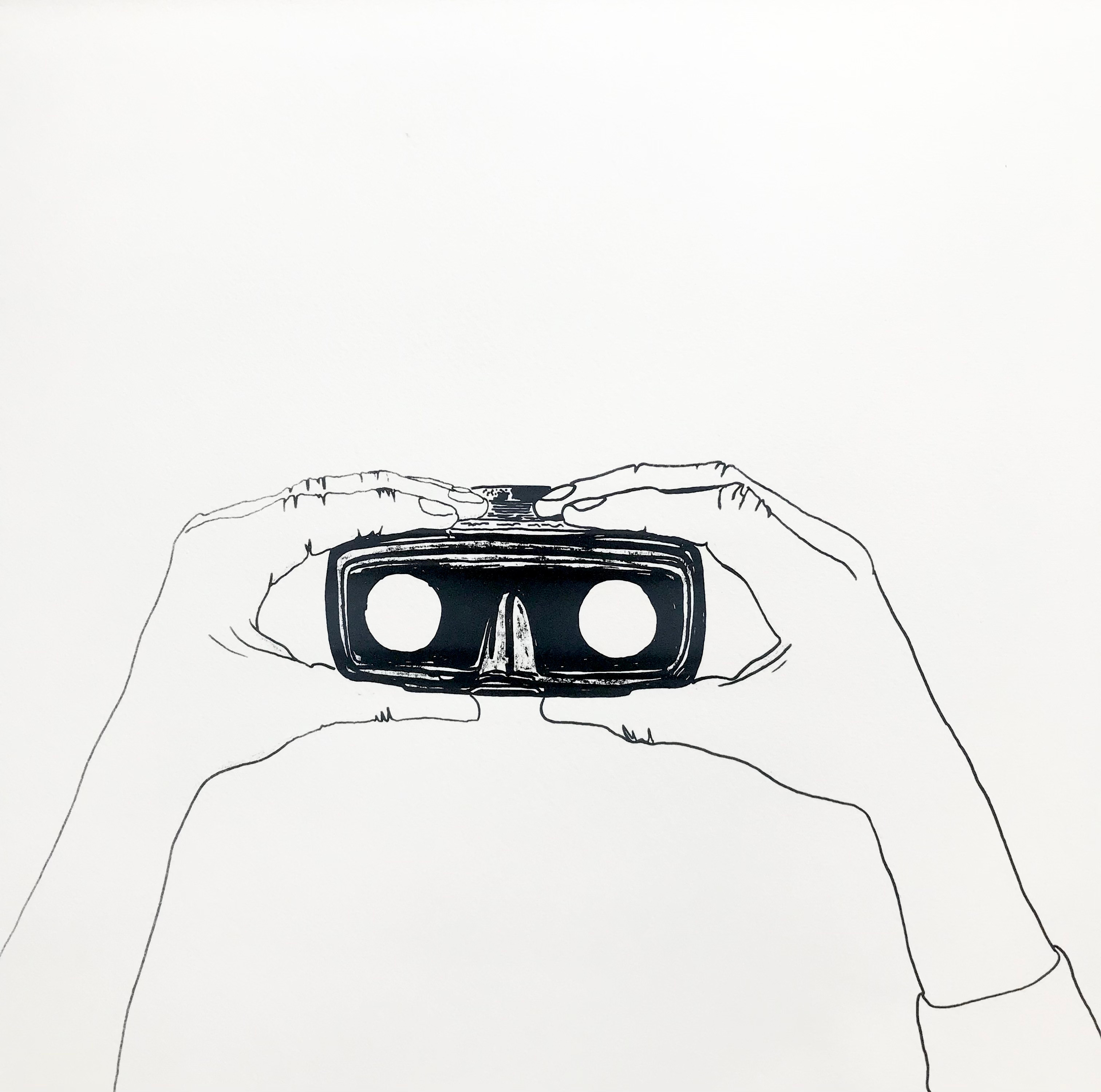
(Untitled. Silkscreen. Corrie Hamm.)
Have you ever heard a word for the first time and then start to hear it everywhere? The word was out there all along but now that you’ve given your attention to it, your RAS follows your attention and basically shows you more of what/where your attention is. It’s like that unsettling thing that happens when you look at particular content online and then more of that shows up in your feed.
Apparently, the RAS doesn’t care what we believe or like or what’s good for us— it just follows our attention and erases anything outside of that. On the upside, this is a super great function when I’m having coffee with a close friend and I wanna hone in on our convo and ignore all the other convos and bustle around me. It would be a drag to be overwhelmed by constant sensory info when we wanna focus on something particular. Also, when I’m giving a lot of undivided attention to ideas and intuition that has to do with my writing or other creative practice, my RAS helps me notice more along those lines.
On the downside, if we’re hung up on a certain opinion or idea, our RAS can basically render anything in opposition to that as invisible and non-existent—making it real tricky to even recognize another point of view. When I say invisible I mean in the same way I didn’t notice a single Mazda 3 on the road until I started driving one.
And what if all of my attention is toward the wrongs in the world or the dark side of human behaviour or my own flaws? Am I just gonna see more of that? I like to think that we’re more than machines (or slaves to our biology)—otherwise, this might start to sound a little bleak.
I’m not sure if our awareness is held in the brain (I also like to wonder about our existence beyond the brain) but we do actually get to choose where we place our attention. If I’m having a rough day, I get to choose the thoughts and things I give my attention to. I can seek out opinions and ideas that contradict my own or I can listen openly to them without judgement.
Basically, we can conduct our RAS and treat it as an ally or a tool for personal expansion and well-being— or we can be strung along by it. We can either create symphonies from our experience or give in to what feels like constant clanging. We ultimately get to shape our perception even if it’s through our neural framework. How do we do this?
Personally speaking, I use my awareness to notice where my attention is— if it’s directed to negative thoughts then I’ll usually pick up a book or start wondering about something that amuses me or gives me a sense of peace. Steering my focus to a curiosity is often more effective than getting into a meditative place (depending how stressed-out I’ve let myself become)— though attention to our own breath is super powerful.
Another way to think about harnessing the power of the RAS is to choose thoughts and ideas of what we want to come into our lives. The RAS will show us more of what we would like to experience if that’s where our attention is—we’ll notice more things, people and places that will ultimately lead to our alignment and well-being. Kinda like seeing the signs (without reading into things in a superstitious way).
I was all over this subject of attention and perception back in art school (I still am and I’m still learning more about it). I’ve realized that we tend to perceive things as photo still shots despite everything being in constant motion and all fluid (there’s neuroscience behind this, too, but I don’t wanna get into it here). All that stuff between each photographic still is habitually edited out.
We can get stuck living a photo album where we’ve carefully arranged each image and experience so that we sit in a tiny room and continuously flip through the same pages— in which case, it’s easy to say that people never change. I clued in that my creative impulses offered doorways out of the confined rooms I built for myself—because an impulse guided my attention toward an in-between space of the unknown and, hence, expanded and altered my perception.
Outside of an art-making context, an impulse is basically a spontaneous reaching toward something curious and unknown that we’re mysteriously drawn to but don’t necessarily know why.
This further led me to a deeper understanding of a concept I came across called ‘free-floating attention.’ But I’ll save that one for my next letter:)
I will be the gladdest thing Under the sun! I will touch a hundred flowers
And not pick one.
~Edna Millay
Warmthness,
-Corrie
P.S.
While writing this letter, I bumped into some information about the Ainu people of Hokkaido, Japan. They believe they are born with a personal guardian spirt called a Turenpe that enters in and out of the back of one’s neck and shapes their personality as well as their fate.
I’m not saying that just because the RAS and Turenpe share a location and deeply influence us that they’re related…but what if they are? (biology is cool but it can’t have all the answers)
References:
Neuroanatomy, Reticular Activating System. Joseph H. Arguinchona; Prasanna Tadi: https://www.ncbi.nlm.nih.gov/books/NBK549835/
The Shamanism of the Ainu of the Northwest Coast of Southern Sakhalin. Emiko Ohnuki Tierney: https://www.jstor.org/stable/3773094#:~:text=The%20Ainu%20terms%20applied%20to,guardians%20of%20aII%20human%20beings.