
Free-floating Attention
Just look. But don't look for anything.

dear creators,
One of the things my artworks taught me is to Just look. But don’t look for any ‘thing’. Looking is about enhancing our perception, not about results.
I wasn’t able to put that into words when I first started to experience it. Initially, I had simply made a decision to act on impulse and then follow the results of those impulses without trying to make something in particular. This created space for something I didn’t already know and I’d never seen before—enhancing my perception.
As I tried to make sense of this (so that I could talk about), I came across a psychoanalytic term called ‘free-floating attention.’ It’s known as “Freud's clinical technique of evenly-suspended attention [that] involves a tension between attentional modes (a paradoxical willing-not-to-will) and this willing unwilling (a kind of free will) undercuts both rational and emotive modes of comprehension, thereby permitting novel prehension of self and other.”*
In other words, just look and listen but don’t look or listen for anything in particular— and there’s a good chance you’ll learn something new.
(I wanna note that if you peer into any eastern philosophy you’ll find that this concept isn’t a Freudian invention—though he may have been the first to bring it into the Western Psychology realm)
As far as I understand, Freud was basically attempting to avoid applying psychological theories to his patients so that he could learn something about their unique situation in the present moment that might not fit current understanding (not to say that Freud didn’t get hung up on his own theories).
We’ve all got a thing about applying a theory to our experience. It may be a personal theory or one we picked up in a particular field of study but most of us have a hard time not seeking immediate answers or coming to conclusions based on what we’ve already learned. I can’t think of a field of work that doesn’t keep coming up with new theories to enforce as the latest best practice and then wants everyone to subscribe to those.
I’m not saying that theories aren’t useful. I’m really into theories, actually. But I also wanna honour and explore the immense complexity of life and full spectrum of human experience. As much as I marvel at patterns and cycles, I am way more psyched about anomalies— those surprise ‘somethings’ that keep theories in line or turn them on their heads. Gotta keep the opposites balanced, right?
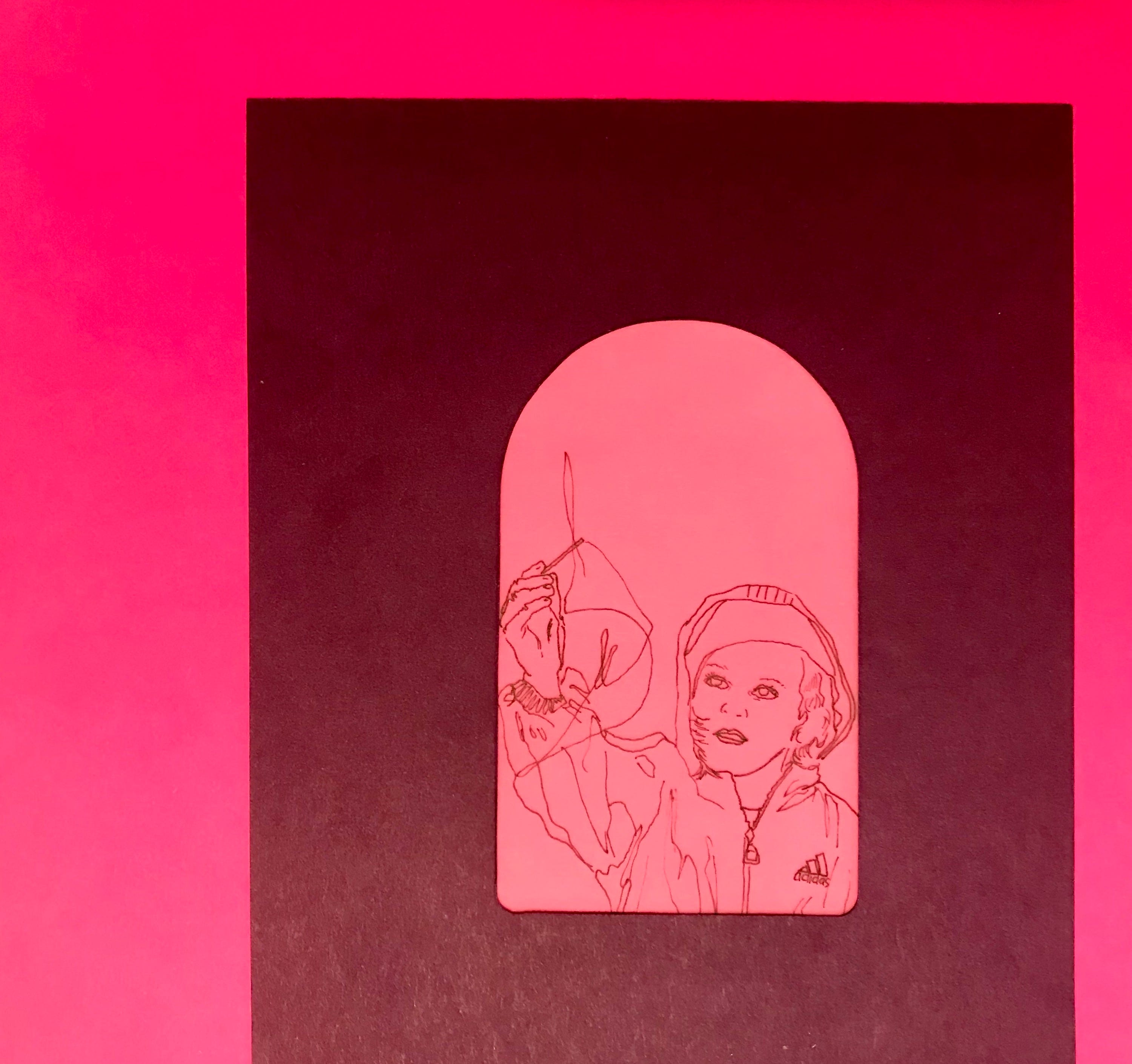
(an image I cooked up for this letter)
What does this look like in my creative practice? Basically, I don’t apply an idea of what to make work about and I’ll never start with a theme. This is because there’s a part of me that wants to make things fit the theme or idea and this contrived presence creates major interference with my ability to maintain a free-floating awareness and an expanded perception. This may not be an issue for others so let me be clear that I’ve got nothin’ against themes if that’s anyone’s jam.
Also, and as I’ve said before, I welcome anything that shows up in the making— even if it could be classified as fugly, mediocre, a failure, offensive, etc.
As simple as free-floating attention sounds, it can be tricky as hell! Why is that? Now that I look back, I remember having to make a big leap beyond a deep insecure feeling. I mean, free-floating sounds nice except that it means you’re sorta suspended alone in the dark while allowing everything known and unknown to fill the room with you. There was a part of me that was dead-set against this but once I gave in— dang, that is a truly free feeling and secure sense of being that doesn’t hinge on anything external.
As I’ve been working on this letter, I revisited a book I got my hands on during the 2020 lockdown called A Life of One’s Own, by Marion Milner. In 1926, this British psychoanalyst and writer devoted herself to a seven year ‘experiment in living’ to sort through the inner muck that kept her genuine happiness at bay. She chronicled all of her doubts, delays and phoney trails to realize that most of us are totally different beings than we think we are— and that the things we are gunning for the most in our lives are least likely to offer lasting joy.
This book could have been written today and along the lines of this subject of attention (and what I was aiming to describe above) she wrote,
“I had just begun to ponder over the fact that all the things which I had found to be sources of happiness seemed to depend upon the capacity to relax all straining, to widen my attention beyond the circle of personal interest, and to look detachedly at my own experience. I had just realized that this relaxing and detachment must depend on a fundamental sense of security, and yet that I could apparently never feel safe enough to do it, because there was an urge in me which I had dimly perceived but had never yet been able to face. It was then that the idea occurred to me that until you have, once at least, faced everything you know — the whole universe — with utter giving in, and let all that is “not you” flow over and engulf you, there can be no lasting sense of security.”
Another thing I bumped into while thinking about our resistance to free-floating attention comes from the philosopher, Jiddu Krishnamurti:
“Human beings are hurt, from childhood. You’re hurt—if you see that as an actuality, that the very essence of you is hurt, then what will you do about it? You, who are hurt, what is the ‘you’? The image you have about yourself? The process of thought is hurt. And how do you prevent future hurts? Do you want to wipe out your hurts, or do you love your hurts?
There is great pleasure in keeping them because that gives you vitality, energy to hurt somebody else. Everything in the world is put together so that it hurts you. And seeing the results of being hurt—you want to hurt others. From that arises anger, resistance, you withdraw, and the more you are inwardly separate, withdrawing, the more you’re hurt.
So you build a wall around yourself. Is it possible to live without a single image? Which means no conclusions, no prejudice, no…you follow? At the moment when you insult me, the moment you say something contrary to the image which I have about myself—at that moment, if I am aware of what you’re saying, give my total attention to what you’re saying, then there is no registration taking place.
It is only when there is inattention, the registration of hurt takes place. Attention is like a flame that burns out the past and the present hurt.”
(from J. Krishnamurti - Brockwood Park 1976 - Public Discussion 1 - How do you observe your fears?)
During my day to day interactions with places and people, I find it most challenging to be aware of my attention— especially if I’m tired, habitually distracted or just acting out of habit in general. If I take a bit of time each day for my creative practice, though, I’m able to consistently apply this free-floating perspective to my work.
The more I exercise this in a safe space (tuning my security) while painting, taking photos, constructing obscure things etc., the easier it is to carry this over into my everyday routine experience with confidence.
Do any of you have experience with this? If not, it might be worth experimenting with:)
“The tree which moves some to tears of joy is in the eyes of others only a green thing which stands in the way… As a man is, so he sees.” -William Blake
(or maybe it could also be vice versa: as we see, so we are)
Samhain blessings,
~Corrie
Other References:
Psychoanalytic Dialogues The International Journal of Relational Perspectives Volume 7, 1997 - Issue 6 On free‐floating attention Robert Langan Ph.D. Pages 819-839 | Published online: 02 Nov 2009